|
The
quest for high level, wide angle (RC9) photography (and in colour)
began, in Adastra's case, in early 1973 following a suggestion
from the National Mapping Council, (per Joe Lines). The only 40,000
foot capable aircraft within Adastra's financial reach was the
Hawker Siddeley HS125. We requested from Qantas and were given
relevant performance figures. We were also able to put the tape
measure over a Qantas HS125 with regard to the physical fitting
of the RC9 camera, (Jack McDonald, our works manager, in charge).
Then in June of 1973, we learnt of an HS125 being on the market.
This was VH-TOM which belonged to a large wholesale grocer "Tom
the Cheap" and which was operating out of Perth. Consequently
I went over to Perth and was given a demo flight on 23rd June
1973. (Max Garroway, who had been one of Adastra's top survey
pilots, agreed to accompany me on the flight. Max had resigned
some years earlier and was now the W.A. manager for Michelin.)
Before the flight I had given the pilot, a young man named Barclay
Archbold, our requirements for survey operation - mainly to take-off
with full fuel and flight at 40,000 feet true. Before the flight
Barclay was straightforward and told us that, under the conditions
requested, we would be disappointed with the aircraft's performance.
And so it proved to be. The HS125 with full fuel climbed magnificently
to 40,000, but as a survey platform at that weight, was hopeless.
It actually wallowed. Barclay then agreed to my request and we
stooged around until we could ascertain the fuel limitation to
enable stable flight at that height.
In spite of this setback (we would be losing about 30 minutes
duration) it was decided to press on with the investigation. To
this end, East-West Airlines, who were about to take-over Adastra,
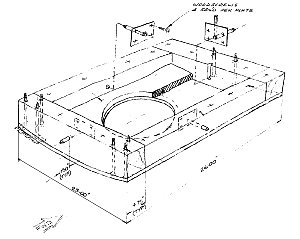
fabricated a light weight pattern of the RC9, and David Ham of
Qantas designed a cradle for the camera and its fitment in the
rear of the HS125.
However, physical problems with the latter continued and Qantas
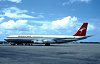
suggested switching to the Boeing 707 for the test programme.
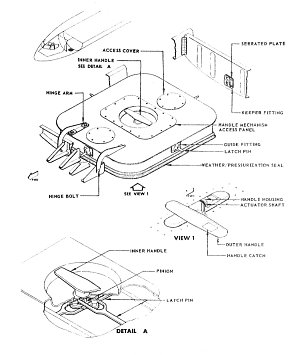
David Ham showed that the RC9 could be fitted in a fuselage panel
immediately below the cockpit. This panel gave access to a pressurised
compartment which could also be reached from the navigator's station,
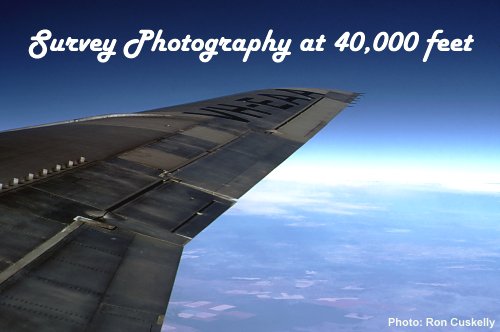
behind the captain's seat. The aircraft chosen for the modification
was VH-EAA and the camera installation was made without problem.
Our first test took place on 20th December 1973. VH-EAA was on
acceptance after a major, and takeoff and landing were both at
Mascot. The weather turned sour during the flight and we ended
up over 8/8, so my only job was to go through the routine of setting
up the camera (i.e. drift, time interval, level) and making sure
the on/off was working. This switch operated by way of an extension
lead which I held in the cockpit.
The flight could have been termed a fizzer but at least the ground
work (literally) had been proven, and all we awaited was another
opportunity both weather-wise and a suitable VH-EAA flight.
Costing, as always, was a major consideration and although N.M.C.
maintained their interest, no contract would be made until Adastra
had produced a sample run. Chartering a 707 was out of the question,
but to help out, Qantas now suggested an economical way of achieving
our aim. Periodically EAA ferried crews to Avalon for training
and we were offered a block of time during the ferry, for our
work at 40,000 feet.
However, before a second opportunity arose, EWA, now the owners
of Adastra, seemed to lose interest in the project. There was
also a further small contretemps in that Adastra and I parted
company in May 1974.
Lou Pares, our General Manager, was overseas and in his absence,
being his deputy, I was in charge, but sadly had a serious run-in
with John Riley, the G.M. of EWA. The latter were, no doubt, dab
hands at moving passengers and freight around the countryside,
but knew precious little about air survey. Anyway, my dispute
with their top man was enough to give doubts about the future
and I resigned.
Pares, on his return, was determined to regenerate the project
and asked me to act as standby consultant and navigator. This
I agreed to readily, as I was as interested as he.
But it was late in the year before the scheme got underway again,
and no Qantas ferries coincided with survey weather until January
1975, when the first trial since December 1973 occurred. The flight
was moderately successful in that we had produced survey photography
at 40,000 feet. However, the quality of the prints was substandard,
and adjustments to aperture, exposure time, filter and camera
heating were required.
Then over the year another five flights were made with little
achieved (mainly due to a series of camera faults or poor weather)
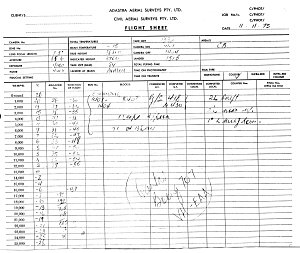
until the last on 11th November 1975, when good quality survey
photography resulted. My records of the seven sorties are rather
scant but below are listed such details as I retained.
|
20DEC73
|
Sydney to Sydney |
Nil
photography due weather. (Note: 1) |
|
20JAN75
|
Sydney to Avalon |
Encouraging
result. |
|
17MAR75
|
Sydney to Avalon |
Nil photography
due weather. |
|
01APR75
|
Sydney to Avalon |
Camera u/s. |
|
??JUL75
|
Sydney to Avalon |
Camera u/s.
(Navigator was Lance Nichols. Self in Brisbane). |
|
02OCT75
|
Sydney to Avalon |
Camera u/s
and weather unfavourable. |
|
11NOV75
|
Sydney to Melbourne |
Survey run
over Canberra. |
Some Comments on the
11th November Flight:
| (a) |
VH-EAA took-off
with full fuel (an error) and was thus overweight for an Avalon landing, and diverted
to Melbourne. |
| (b) |
The aircraft
weight, combined with ATC requirements, meant we had climbed to only 37,000 feet
when Canberra was in view. As Cu was forming, I decided that a photo result was
more important than the lower altitude and we moved straight on to the run. |
| (c) |
The
target run included Parliament House, which we crossed at
1400EST, on a day which has gone down as one of infamy in
Australia's constitutional history. Read about The
Dismissal |
Postscript:
All our work with its attendant delays and frustrations, was for nought, as shortly
after that last and successful flight, satellite imagery became readily available.
Mike Wood
February 2003
|
NOTES
|
|
1
|
This
flight is recorded in the log book of F/O Joseph (Jock)
Ross as:
20DEC73
VH-EAA
Captain Anderson
Sydney-Sydney
Test Flight and INS check and camera run at 40,000 feet.
3 hrs 50 mins.
|
|