|
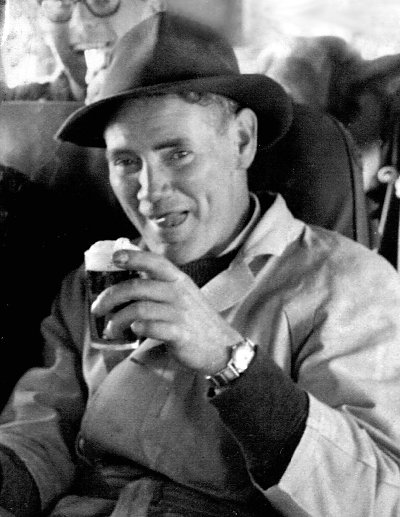
Les
Sheffield ("Shifty" to his mates) began working at Qantas in May
of 1943. On 1st August 1944 he was invited to join the RAAF where
he stayed until 15th March 1946 recommencing work with Qantas on
the 4th April that year. On 12th November 1946 he was issued with
Aircraft Maintenance Engineer Licence No 2526. He stayed with Qantas
until 30th May 1947 and joined Butler Air Transport on 2nd June
1947. He worked with Butler until the 26th March 1954 when he left
to join Adastra Hunting Geophysics where he stayed until 24th September
1966 when he was killed in the Tennant Creek crash of Lockheed Hudson
VH-AGE. His Licence was last renewed on 11th December 1964 and was
valid to 31st December 1966 and at that time was endorsed "All Electrical
Installations Group 1, All Electrical Installations Group 2, All
Instrument Installations Group 1, All Instrument Installations Group
2".
His reference from Butler Air Transport states that "During this
time he was employed as an Approved Electrical Signatory in our
electrical overhaul shop dealing with generators, magnetos, starters
etc, also the installation of all electrical equipment in our aircraft."
Les Sheffield was my father and I his eldest son. In gathering this
information I learnt things I did not know and, more to the point,
understand many things that were mysteries. One example is that
I now understand how he was, in the latter years, on a first-name
basis with the heirachy of Qantas - he had grown up with them.
The period with Adastra was one of innovation, experimentation,
and invention. Les designed and built an electronic (valve) timer
that was used in the photo labs. That was quite early in his time
with the company and I remember that some years later the office
reported that someone had called trying to sell them copies of the
same thing. Les never thought of patenting anything or even trying
to sell them to Adastra. They were designed by him and built in
the workshop at our family home in Picnic Point but they were given
away because they were able to assist the photography.
Les installed pyrotenax heating cable around cameras to prevent
fogging and allow clear photogaphy in most conditions. He worked
with the manufacturers of the cable and an offshoot of that was
we had pyrotenax cable under the carpet in our lounge room. He often
made mods to cameras or their operating conditions and as a result
the house phone often ran hot with calls from overseas.
The Picnic Point workshop was DCA approved for the overhaul of electrical
and instruments. It was originally the garage but was lined and
floored to meet DCA specs. Quite a bit of gear used to come down
from PNG and Les was the only person authorised in the South Pacific
for much of the instrumentation in the growing light aircraft field.
The workshop was quite busy until it was set ablaze by someone's
cigarette. I think the workshop was in operation for about ten years
from 1954 or 1955. Les was, to the best of my knowledge, on a contract
with Adastra from quite early in his time with the company and certainly
during the later years. This enabled him to carry out other work
and that included working for Qantas at Rose Bay.
DCA (Department of Civil Aviation) approved or censured modifications
but Les seemed to be on a first-name basis with anyone that mattered
there too. Often I heard the remark, "We don't want to know what
you're doing but do it out to sea!" One such occasion was the installation
and testing of the 'flame-thrower' heating system in a Hudson. I
was in the Hudson for the first trial and it was indeed spectacular
and frightening - at first.
Two of the Hudsons (VH-SMO & VH-SMM) were owned by the Sydney Morning
Herald. These aircraft had much of their service done at Camden
which was mostly an RAAF base with a couple of spare hangars when
I first went there in 54/55. One of the hangars was owned by the
Herald and run by Gwynn Davies, Chief Engineer. Les did the electrical
and instrument maintenance and I especially remember the compass
swings.
In 1956 or 1957, Les with other Adastra crew, flew to Giles in Bristol
Freighter VH-AAH to set up the weather station. They took some fascinating
35mm film using Adastra's Bolex but that film, I suspect, has since
been lost. Les did the electrical and instrument maintenance on
the Freighter. This aircraft crashed at Albion Park on 18th December
1961, two days after I had flown from Hobart to Sydney in it with
Les and Lionel.
In February 1964, the destroyer HMAS Voyager was lost in
a collision with the aircraft carrier HMAS Melbourne. I have
a recollection that Les went with a Hudson crew to Jervis Bay to
obtain photos of the damaged HMAS Melbourne at sea but I
do not know the crew and have not been able to find any copies of
those photographs.
Les did a lot of work at Bankstown for Doug Fawcett and much of
this in the latter period was on a new aircraft, the Fawcett 120,
which never went into production. (The sole example of this aircraft
was restored by Doug Fawcett not long before his death and donated
to the Australian Aviation Museum at Bankstown. Ed.)
In September 1966, Les was called to Tennant Creek to fix a problem
with the equipment in Hudson VH-AGE. He was not expecting to be
away for long so he had made a return booking from Mount Isa on
22 September. While he was in Tennant Creek, it became necessary
for another member of the crew to return to Sydney. As Les was not
ready to return, he sent this crew member, Harold Bagot, in his
place. The aircraft operating Ansett-ANA Flight 149 from Mount Isa
to Brisbane on 22 September 1966 was Vickers Viscount VH-RMI. Tragically,
history records that this aircraft crashed near Winton with the
loss of all on board. Les telephoned home the night of the Viscount
crash, primarily to advise the family that he was not on board the
Viscount, but he also stated that they had flown over the site of
the crash and photographed it*. Tragically, just two days later,
Hudson VH-AGE crashed at Tennant Creek with the loss of all on board,
including Les. Thus, in a cruel twist of fate, the outcome would
have been the same for Les regardless of which aircraft he had flown
on.
Before leaving for Tennant Creek, Les had been invited by Gwynn
Davies to develop a workshop in the Herald Flying Services hangar
at Camden. Les had intended to explore this further on his return
from Tennant Creek but sadly it was not to be.
Trevor
Sheffield
June 2006
| * |
For
more information, refer to the history of Hudson
VH-AGE. |
|