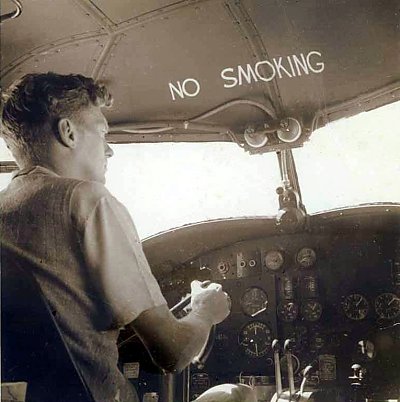
|
In
the latter part of 1945, I was posted to No 3 Communications Unit
at Mascot, where I expected to remain until my projected discharge
date of May 1946. No 3 C.U. was only a small unit comprising a couple
of Avro Ansons, one D.H 84 Dragon, one D.H. Tiger Moth and for a
short time one Norseman which was damaged in a landing mishap and
removed from unit strength.
After 4 years in the RAAF I had a total of 1300 flying hours. Included
in this total were 478 hours on Airspeed Oxfords, 190 hours on D.H.
Dragons and 216 hours on Avro Ansons. Most of our flying at Mascot
consisted of a daily return courier flight to the big RAAF stores
depot at Dubbo. Other odd jobs were carried out by the Ansons, and
consisted mainly of co-operative work for the School of Radio Physics,
co-op work with HMAS Watson etc.
One of my last jobs with the RAAF was flying an Anson in formation
with Kingsford Smith's "Southern Cross" for a camera crew from Cinesound
Studios. The film "Smithy" was under production, and the producer
wanted air to air footage of the "Southern Cross" against a background
of large cloud build ups. I never did get to see the finished film.
Sometime in October or early November 1945, I learned that Adastra
were converting a couple of ex RAAF Ansons for aerial survey work
in addition to their D.H. 90 Dragonfly VH-AAD. More or less out
of curiosity I contacted Adastra to see if they had a vacancy for
a pilot. Following an interview with Capt Frank Follett, I was invited
to submit a written application which was accepted on 13th November
1945, and from that point 'things' happened pretty quickly.
(See Gordon's employment letter
from Frank Follett)
December 3rd 1945 marked my formal discharge from the RAAF. On 10th
December 1945, I did a 60 minute conversion on the Dragonfly, followed
by a few more circuits in the next few days.
During this time I was also busy becoming acquainted with the ground
office, film processing and mapping staff, and Chief Engineer Eric
Haynes and his hangar staff. It was also the time to get to know
Harry Morrell, who was to be my camera operator/navigator. Harry
hadn't had much in the way of previous flight experience, but we
soon developed into a pretty good team, as well as good mates. On
the 14th-17th December, we carried out a few practice over-lapping
mapping runs. Our first actual job was photographing Baulkham Hills
from 6,000ft on the 21st December.
By this time I was feeling pretty comfortable with the Dragonfly,
and with Harry also coping well, it was adjudged time for us to
head off to Victoria, to start mapping virtually the whole of that
State. Accordingly, on the 22nd December 1945, we departed Mascot
and flew direct to Essendon, flight time being 4:10. At Essendon
we were greeted by Joe Linfoot, Jack Howard and Tom Carpenter who
were crewing Anson VH-AGG.
After spending a pleasant Christmas in Melbourne, both crews moved
to Ballarat, where the aerodrome was still an Air Force base. We
lived in local hotels, but both aircraft had hangar space at the
base, and we were extended the courtesy of being made honorary members
of the officers mess.
In mid-March, Harry and I moved base to Hamilton. From then until
June 1947 we covered a large area of the state, operating mainly
from Hamilton, Kuong and Nhill. During this time we flew a total
of 470 hours with the Dragonfly, with it proving to be a most reliable
little aircraft. With just two Gipsy motors pushing us along, the
climb from take off to our normal operating height of 12,000ft was
not all that spectacular, but having reached there, it quite happily
pushed along for hour after hour. Without the benefit of an auto
pilot, or modern day satellite assisted navigation systems, the
actual flight runs were pretty demanding, requiring a high degree
of concentration from both the pilot and camera operator.
On 12th June 1947 we flew VH-AAD from Wagga back to Mascot and that
was the end of what had been an interesting and enjoyable experiment
with the Dragonfly.
The remainder of my time with Adastra was spent flying the Ansons
(in total 1,464 hours in my time with Adastra). Tom Carpenter joined
us as a flight crew member and highly skilled licensed aircraft
engineer. Over the next few years we operated from various bases
including Broken Hill, Adelaide, Mt Isa, Roma, Derby, St George,
Moruya etc. Tom and I became good friends, and it was during this
period that Tom met his future bride Vilma at Roma. Similar good
fortune befell me at St George where I first met my wife Ishbel.
By the end of 1951, and with married life looming, it was time to
say farwell to my somewhat vagabond days with Adastra. In March
1952, I joined Butler Air Transport and some 3 years later I moved
to Lae, New Guinea to fly with Mandated Airlines. It was at Lae
that I again met up with Adastra crews now operating Lockheed Hudsons.
Joe Linfoot and crew were the first to arrive, and it was great
to catch up with them again. They were later relieved by Jack Howard
and crew who were in turn followed by Allen Motteram. With Allen
were Pat Murphy as navigator and Gordon Murrell as camera operator.
Pat had recently qualified for his commercial licence, and was keen
to start a career as an airline pilot. As it happened, MAL were
actively recruiting at this time, having lost two new recruits in
fatal air crashes before they even arrived in Lae. I can't recall
their names, but one died in a light twin accident at Archerfield.
The second young pilot was killed in a solo crash, somewhere in
NSW, possibly as a crop duster. When Pat approached MAL with a view
to possible employment, we were only too happy to accept his application.
Unfortunately for MAL, and tragically for Pat, the old saying that
"things happen in threes" was to prove only too true.
On the morning of 24th June 1957, Allen was carrying out a practice
single engine approach and landing at Lae in Hudson VH-AGO. On final
approach, the aircraft ran into turbulence and down drafts. With
one motor feathered, landing gear down and full flaps extended,
the pilot couldn't retain control when he had to apply full power
to the operating motor to try to make the end of the runway. The
Hudson rolled and plunged into the sea with no survivors. This tragic
and sad day marked my final association with Adastra.
Gordon Bigg
April
2005
Footnote:
Gordon
Bigg passed away on the Gold Coast on 14 February 2008. His funeral
was held on 20 February 2008.
|