QuestionsGuestbookPhoto AlbumOperationsEquipmentProjectsPeopleAircraftCompanyUpdatesWelcomeHomeSearch


AERODIST


Larger Image


The following description of Aerodist appears on page 2 of the August 1965 issue of "Australian Aerial Survey Review".


"Aerodist represents an example of Adastra's co-operation with the National Defence Services.

This instrument is made in South Africa by the producers of the widely-used tellurometer system, which is operated by microwave, and used for ground measurement of geodetic distances.

As used in Adastra aircraft, Aerodist is designed for simultaneous measurement, during flight, to three ground stations, known respectively as Red, White and Blue.

Its function is long-range extension of horizontal control, and aircraft positioning in aerial survey.

The immediate effectiveness of Aerodist was seen in New Guinea when Adastra began to fly an extensive project on behalf of the Australian Army Survey Corps.

First, Army land parties established ground stations, the most onerous part of the operation.

Survey Corps men were landed by helicopter in small clearings with equipment and supplies in jungle country.

In one case, Army technicians found themselves working among the clouds, on the brink of a 2,000 feet drop.

Speed of Aerodist survey resulted in as much progress being made in an hour as would have been achieved in six months by land parties using conventional methods.

Aerodist gives accurate long-range extension of horizontal control in three ways.

These are:
[1] distance measurement between ground stations, using the aircraft as an intermediate station (line-crossing technique)
[2] fixing an unknown ground station from two known ground stations using an aircraft and continuous trilateration
[3] fixing two unknown ground stations by the foregoing means.

Aerodist accurately positions an aircraft in flight, continuously or at an instant of camera exposure, and also determines altitudes.

In the Adastra aircraft, these facts were obtained by obtaining a fix in space as function of three slant distances, using the Aerodist three channel system, and by using two channels to measure slant distances while the third channel gave direct height measurement from a ground station established at a known height, the ground station antenna being set vertically."


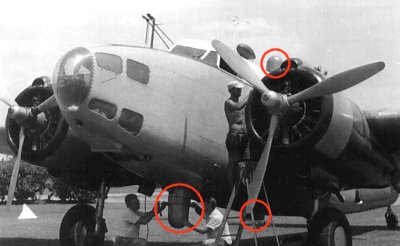
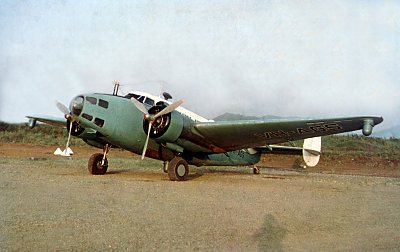
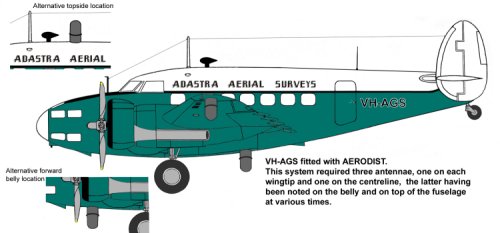
The three channels of the Aerodist system required three separate antennae, one under each wing tip and one on the fuselage. It would appear that the initial configuration had the fuselage antenna on the belly towards the aft end of the bomb bay (photos A and B). As will be seen from these photographs, the ground clearance in this position was minimal (the antenna was not retractable).

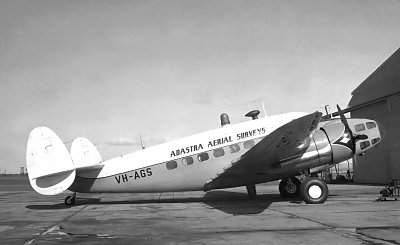
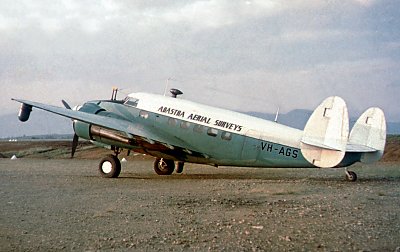
Photo E shows VH-AGS with one antenna on top of the fuselage aft of the D.F. loop fairing, and another on the belly, but towards the front of the bomb bay. Although it is difficult to tell in this photo, there is a suggestion that this belly antenna might have been offset slightly to starboard. Presumably the wing tip antennae were retained in this configuration. Whilst it is not known that a belly antenna was ever damaged by ground contact, it is easy to speculate that alternative locations on the fuselage were being investigated with the configuration shown in photo E.

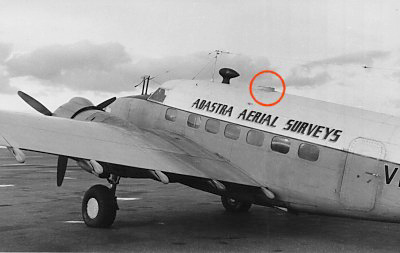
By late April 1965, VH-AGS was being operated without any Aerodist antennae, although the aircraft retained the mounting for the upper fuselage location (photo F). It is believed that VH-AGS was the only Adastra Hudson to carry the Aerodist installation.


Larger Image

PHOTO A: Photographed by Dave Aitchison at Mount Hagen in 1965, VH-AGS carries what is believed to be the original Aerodist fit. Note the minimal ground clearance of the belly antenna!

Larger Image

PHOTO B: Photographed by Dave Aitchison at Mount Hagen in 1965, VH-AGS carries what is believed to be the original Aerodist fit. Note the minimal ground clearance of the belly antenna!

Larger Image

PHOTO C: Keith Cooper walking through the Mount Hagen camp in 1965. The camp was constructed by the Army with the hut on the right being allocated to the Adastra crew. Photographed by Dave Aitchison.

Larger Image

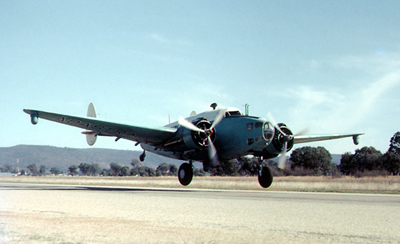
PHOTO D: VH-AGS in Aerodist configuration touching down at an unknown location, possibly Albury. Photographed by Dave Aitchison

Larger Image

PHOTO E: This undated photo of VH-AGS supplied by Kevin Pavlich shows an Aerodist antenna on the top of the fuselage aft of the D.F. loop fairing and another on the belly. Also visible is what appears to be the mounting for the original aft, belly position. It is presumed that similar antennae were mounted on the wing tips but this cannot be ascertained from this photo.

Larger Image

PHOTO F: Photographed at Brisbane on 29th April 1965 by Ron Cuskelly, VH-AGS retains the mounting for its topside Aerodist antenna. The aircraft did not carry any Aerodist antennae at this time.


Issue Date
3 12JAN04